Donald Trump’s Second Term as U.S. President: Impact on Africa and Global Politics
Explore Donald Trump’s return as U.S. President, its implications for Africa, and how the continent can navigate challenges in trade, aid, and global diplomacy.
 admin
admin
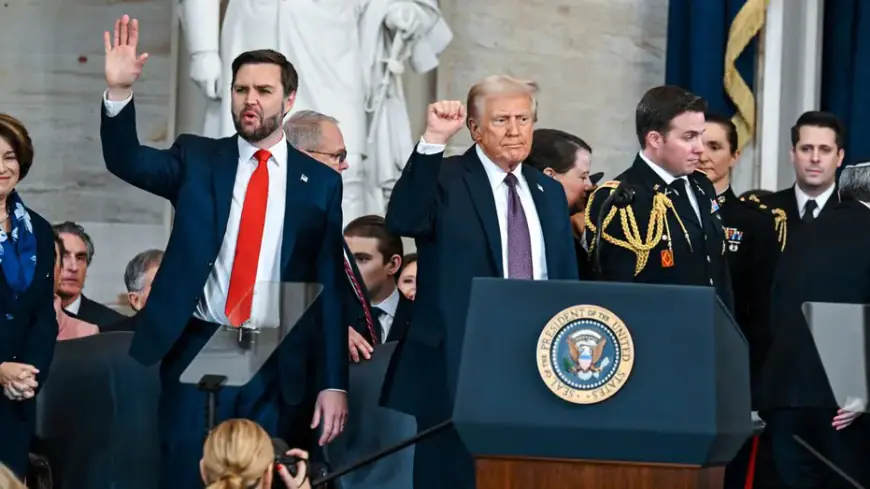
On January 20, 2025, Donald Trump was sworn in as the 47th President of the United States, marking a historic comeback after serving his first term from 2017 to 2021. At 78, Trump also became the oldest individual to take office as U.S. President, with J.D. Vance, a 40-year-old millennial, sworn in as Vice President alongside him.
A Historic Inauguration
The inauguration ceremony took place in the U.S. Capitol Rotunda due to harsh winter conditions. Chief Justice John Roberts administered the oath of office, with Trump placing his hand on both the Lincoln Bible and a childhood Bible of personal significance. This symbolic act set the tone for a presidency he claimed was "ordained by God to make America great again."
Trump’s speech, delivered to a divided audience, centered on nationalism, economic sovereignty, and the pursuit of a "merit-based" society. He declared the day as "Liberation Day" for the American people, vowing to end what he described as “political correctness” and prioritize American interests on the global stage.
Immediate Actions and Policy Shifts
In his first hours back in office, Trump signed a series of executive orders reversing key policies of the Biden administration. Notable actions included withdrawing the United States from the World Health Organization (WHO) and the Paris Climate Agreement. He also announced the establishment of a new Department of Government Efficiency to cut bureaucracy and streamline federal operations.
These moves signaled a return to Trump’s “America First” doctrine, emphasizing protectionism and a focus on domestic issues. While his policies drew applause from his supporters, critics voiced concerns over their global impact.
Global Reactions and Africa’s Stakes
Trump’s return to power has significant implications for Africa. During his first term, U.S.-Africa relations were largely marked by reduced engagement, with Trump’s administration cutting foreign aid and prioritizing economic competition with China, Africa’s largest trading partner. African nations may now face renewed challenges in securing U.S. development assistance, trade partnerships, and diplomatic attention.
The Trump administration’s withdrawal from global agreements like the Paris Climate Accord could also affect Africa disproportionately. As one of the continents most vulnerable to climate change, Africa relies on international efforts to combat environmental challenges. Reduced U.S. commitment to climate initiatives may hinder progress in tackling rising temperatures, desertification, and food insecurity across the continent.
On the economic front, Trump’s renewed focus on bilateral trade deals may open doors for African nations with strong negotiation strategies. Countries like Kenya, which explored a free trade agreement with the U.S. during Trump’s first term, could benefit from such opportunities if strategic partnerships are pursued.
The Role of African Voices
As Trump’s policies unfold, African leaders and citizens must advocate for the continent’s interests in global diplomacy. Pan-African unity and collaboration could serve as a counterbalance to shifting U.S. foreign policies. Platforms like Pan-African Wave play a crucial role in rallying voices across the continent, ensuring Africa’s concerns remain visible on the global stage.
Looking Ahead
Donald Trump’s second term is poised to redefine U.S. domestic and international priorities, with potential ripple effects across the globe. For Africa, this presents a mix of challenges and opportunities. The continent’s leaders and advocates must navigate this new era with resilience, seizing opportunities to strengthen Africa’s position in the evolving geopolitical landscape.
As Trump sets out to "make America great again," Africa must strive to make its voice heard louder than ever.